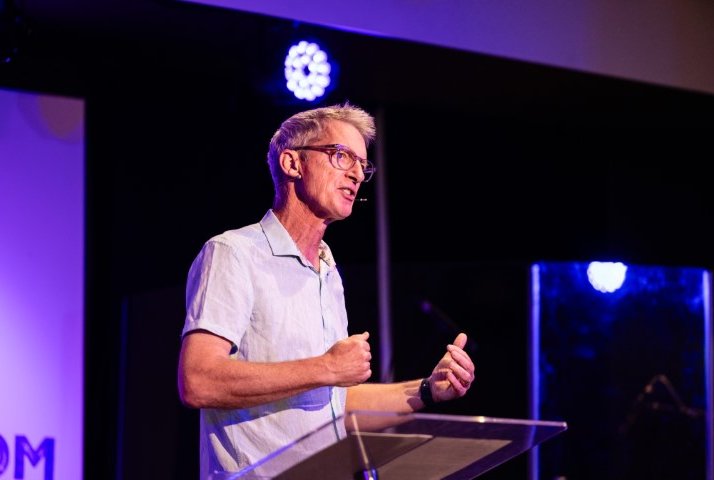
Sunday 18 September
Time to Turn to God
Phil Stedman
Phil walks us through Revelation chapter 16 sharing that the big idea of the chapter is a call to repentance. God gives numerous opportunities for people to turn to Him. Phil encourages us to check the softness of our hearts towards God, to worship Jesus as through the price He paid on the cross we will no longer bear God's wrath, and to use every opportunity we have to share the gospel with others. There is still time to repent, but it is getting shorter.
Life Group questions
Time to Turn to God
The Revelation of Jesus Christ Part 2: Session 2 – Revelation 14 & 15
Cheat Sheet
Mount Zion is the hill where the Jerusalem temple was built. However, for Revelation’s audience, this term had a theological and mystical meaning. The prophet Joel saw Mount Zion as a place of protection from God’s judgement. The author of Hebrews, in Hebrews 12, speaks of a heavenly Mount Zion, where God’s people and angels assemble. It is best to understand John’s use of this term in Revelation 14 as referring to a symbolic place where God’s chosen people are gathered under his protection.
144,000, as was the case in Revelation 7, is most likely a symbolic number referring to the complete number of God’s people throughout history.
A new song, loud and melodic, is sung by God’s people as they rejoice in their deliverance. The reason it is “new” relates to the fact that now God’s people are finally and fully with God. So they sing with a new sense of joy and security.
Those who did not defile themselves with women, one of three things used to describe the 144,000 in Revelation 14, has cause some commentators to speculate wildly about a special group of virgin super saints who also happen to be fantastic singers. More likely, and more appropriate given the surrounding symbolic language, is that this is a symbol of purity, that God’s true people are those who have not let themselves be defiled by participation in the world system.
Some Old Testament prophets spoke of Israel as a virgin; the prophet Hosea lived the opposite truth out in startling fashion. Given that John saw himself as operating in the same tradition as these prophets, his use of such language as a symbol is not surprising.
The wine of God’s fury is an image with Old Testament roots: being on the receiving end of God’s fury was compared to drinking a cup of wine (see, for example, Jeremiah 25:15-16.)
Sickles were tools for harvesting grain, and in Revelation 14, they are used to harvest “the earth,” and then some grapes. These events were first prophesied by the prophet Joel in Joel 3:13, and are best interpreted as images of judgement: time is up, judgement is happening! However, some interpreters also link the idea of a harvest with evangelism, given that Jesus used it in this fashion in Mark 4 and elsewhere. Whether this is the case or not, the idea of Jesus and the angels wielding sickles carries a strong sense of finality. One day, there will be a closure, an end, to things as they are at present. Should this, by God’s grace, also involve one final call to repentance, it will not be embraced by all. Some will be judged and found wanting.
The great winepress in Revelation 14:19 is an image of judgement, first described by the prophet Isaiah in Isaiah 63. As Craig Keener describes it, “sometime around August or September workers collected ripe grapes in baskets and deposited them in long wooden or stone troughs. There, often to the rhythm of a flutist, workers trampled the grapes into juice with their feet…. In Revelation Jesus assumes this divine role.”1 This is a striking metaphor of God’s judgement, where he crushes his enemies underfoot (so too in Romans 16:20.)
Study
Read Revelation 14 & 15
Revelation 14:1-13 contains several subtle challenges to the Christian reader. Work your way through these verses slowly, and stop every time you find something that challenges Christians to live faithfully. (This is made slightly easier if you follow the Cheat Sheet and interpret the first half of verse 4 symbolically.)
What did you find?
Why do you think this part of John’s vision contains so many of these little challenges?
Which of these challenges do you think is most relevant to the contemporary Western church?
The Biblical authors use the metaphor of a harvest in two ways: sometimes it refers to judgement, other times to evangelism. Revelation 14:14-20 uses this metaphor, anticipating a final judgement, and possibly a final call to faith too! Yet this clearly hasn’t happened yet. Jesus told his disciples that even he didn’t know when this final harvest would happen. Yet some Christian feel compelled to speculate.
Why do you think this is?
Given that this harvest is yet to occur, what are we called to do in the meantime? (Hint: answers to this may be found in the previous 13 verses!)
Many Christians long for this harvest to happen soon. They long for a great move of God that brings many repentance. Yet they also long for a final judgement.
Why might Christians long for a final judgement, given the intense and bloody language that is used to describe it?
For victims of injustice and abuse, how might these images be good news?
How can we partner with God in his work as Judge and Evangelist in the present?
Optional Extra Resources
Here’s a song based on Revelation 15:3-4: