Sunday 19 June
A Message of Hope
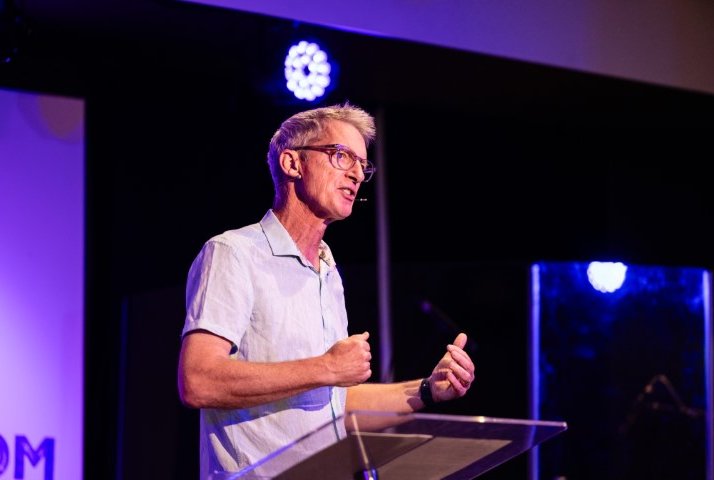
Phil Stedman
Phil walks us through Revelation chapter 7 highlighting how this would have been a message of hope and encouragement for those it was written to who were undergoing intense persecution and hardship. It's a reminder of the saving power of Jesus.
Life Group questions
A Message of Hope
Session 7: Revelation 7
Cheat Sheet
Four angels, standing at the four corners, holding back the four winds. In other apocalyptic literature, angels were often pictured as being in charge of the forces of nature. There are also further references in Revelation to angels who oversee various natural forces like fire (14:18) and water (16:5). Powerful winds were understood as bringing destruction and chaos, so here the angels are holding back a force that could strip the land bare. As for the earth having four corners, this is most likely a common saying (which still turns up in English from time to time), rather than a literal description of John’s beliefs about the shape of the planet.
A seal on the foreheads is a mark protecting the bearer from God’s judgement. This has Old Testament roots in Ezekiel 9:1-8, and also in God’s protective mark on Cain in Genesis 4. Later in Revelation, we learn that the seal is God’s name (14:1-5), indicating that the one sealed is God’s personal property. (Just like we write our name on our own possessions.) This is most likely not a description of a literal mark that Christians will one day have placed on their foreheads. Rather, it supports a recurring theme that runs through Revelation, that God’s judgement is coming, but his chosen people will be spared from the worst impacts of it.
144,000 from all the twelve tribes of Israel is understood by the vast majority of New Testament scholars as a symbolic image, representing the total and complete people of God (who, in verse 9, are described as “a great multitude that no one could count.”) Numbers in Revelation are often used to indicate completeness, and here, the fact that the number 144,000 is reached by multiplying 12, by 12, by 1000, is a key indicator of its symbolic significance. Also, some scholars suggest that the way these words are written is similar to that of a military census. This might remind hearers that God’s people are also his army, gathered to fight a spiritual battle.
Palm branches were used by Jewish people to celebrate great occasions, such as when Jesus rode into Jerusalem in John 12. They were a symbol of victory, and here in Revelation 7 they are waved by those wearing dazzling, white robes, which is itself a sign of being victorious (see the Cheat Sheet for Session 3).
Robes made white in the blood of the Lamb is a paradoxical statement (blood definitely does not work as a fabric whitener) that indicates the source of a Christian’s victory: the redeeming death of Jesus. In Revelation 7, this idea is put alongside talk of enduring through “the great tribulation.” This continues the theme in Revelation that God’s people will endure through seasons of judgement, and even the final judgement will not destroy his chosen.
Study
Read Revelation 7
Scholars often identify Revelation 7 as operating like an “interlude” between the intense scenes of chapters 6 and 8.
What is an interlude? What is the point of interludes in music, drama, and the arts?
What is the point of this interlude in Revelation 7? What does it give us a break from, and what does it do that is different from the scenes either side of it?
Revelation 7 also contains a prime example of juxtaposition. In Revelation 7:4-8, we hear a roll call. As noted in this week’s Cheat Sheet, it is possible that this might have been understood as similar to a military census, where a commanding officer counts the soldiers under his command.
Yet, what do we learn about this army?
Answers might include:
- They are clad in dazzling white robes
- They wield palm branches
- They are bathed in the blood of their leader
- They are multi-ethnic, and speak a cluster of different languages
From a military perspective, not a particularly intimidating or well-equipped group!
What do you think this means? Why do you think Revelation contains this juxtaposition?
Revelation 7 is also packed with allusions to various Old Testament ideas and verses. Yet many of the references are adapted. Sayings and ideas which in the Old Testament were about God are now changed so they are referring to the Lamb.
Compare Isaiah 49:10 and Revelation 7:16-17
What do you think John is doing this in Revelation?
What does this imply about Jesus? What about his followers?
This interlude is important, for many reasons. It’s a celebration of the church. It’s a reminder of the saving power of Jesus. It’s an encouragement during times of intense distress and chaos. Even at the end, when everything is falling apart around us, God’s people will endure, because of Jesus, our Lamb.
Close the session by praying for persecuted Christians. Pray also for Christians who find themselves in war zones, places afflicted by famine and disease, and anywhere where things around are unstable and frightening.
Optional Extra Resources
Have a listen to these songs, which explore some of the themes found in Revelation 7:
https://open.spotify.com/track/4oj1OARlFeZTzHA5d33tAH?si=530dc7a2df5d47da
https://www.youtube.com/watch?v=ysEuw6cxyCU
https://open.spotify.com/track/2re4s98HNlkhVZzGSerVHb?si=7ea63ec6353a40aa
https://www.youtube.com/watch?v=OIahc83Kvp4
Take a look at some early depictions of the scenes described in Revelation 7. Remember, this art was particularly significant for church members who could not read. What do you think of these pieces? If you were not able to read the words of Scripture, how do you think these works would help your faith?
https://media.guim.co.uk/95a15ebbc7d59b94a1da852b294c87d46d70f68d/0_111_2598_1647/2000.jpg
https://upload.wikimedia.org/wikipedia/commons/2/2b/BambergApocalypseFolio018vHomageToLamb.JPG